Comment utiliser un thermomètre à viande pour le porc


 288 Comments


La cuisson parfaite du porc peut sembler délicate. Que vous grilliez des côtelettes de porc au début du printemps, rôtissiez un filet de porc pour le dîner du dimanche, ou fumiez du porc effiloché pour un barbecue, une question demeure toujours : quelle est la température correcte pour le porc ?
C'est précisément pourquoi un thermomètre à viande professionnel pour le porc est l'outil le plus important dans votre arsenal de cuisine. L'utilisation d'un thermomètre à porc dédié garantit une cuisson axée sur les résultats plutôt que sur le simple respect d'une minuterie, vous permettant d'atteindre l'équilibre parfait entre sécurité et saveur à chaque fois.
Pourquoi la mesure de la température du porc est-elle importante ?
De nombreux cuisiniers amateurs se fient à la couleur ou au temps de cuisson pour juger de la cuisson, mais ces méthodes ne sont pas fiables. Le porc peut paraître légèrement rosé même lorsqu'il est entièrement cuit. La méthode la plus sûre et la plus précise est d'utiliser un thermomètre alimentaire pour le porc.
Selon l'USDA, les morceaux entiers de porc, y compris les côtelettes, le filet et le filet mignon, doivent être cuits à une température interne de 63°C (145°F) suivie d'un repos de 3 minutes.
Selon l'USDA, les morceaux entiers de porc, y compris les côtelettes, le filet et le filet mignon, cuire le porc à la bonne température garantit deux choses importantes :
- Sécurité alimentaire : Une chaleur appropriée tue les bactéries telles que Salmonella ou E. coli qui peuvent exister dans le porc insuffisamment cuit.
- Meilleure saveur et texture : La surcuisson du porc le dessèche. La bonne température du porc le maintient juteux et tendre.
C'est pourquoi les chefs professionnels et les maîtres du grill s'appuient sur un thermomètre à viande pour la lecture de la température du porc au lieu de deviner.

Tableau des températures du porc : quelle est la bonne température ?
Différentes coupes de porc exigent des températures internes légèrement différentes. L'utilisation d'un thermomètre à porc garantit la précision quelle que soit la méthode de cuisson.
Température interne recommandée pour la coupe de porc :
- Côtelettes de porc : 145°F – 160°F
- Filet de porc : 145°F
- Filet mignon de porc : 145°F
- Porc haché : 160°F
- Porc effiloché (épaule) : 195–205°F pour effilocher
Les morceaux frais tels que les côtelettes, les rôtis et le filet mignon doivent atteindre 145°F pour une consommation sûre. Cela signifie que l'utilisation des bons outils comme un thermomètre à viande pour les côtelettes de porc, le filet de porc, le filet mignon de porc et bien plus encore est essentielle pour obtenir des résultats parfaits.
Comment mesurer correctement la température du porc
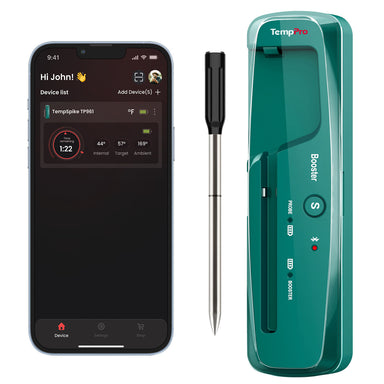
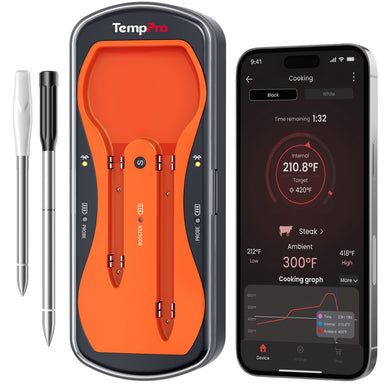
Si vous cuisinez fréquemment du porc à la maison, un thermomètre de cuisson fiable peut transformer votre expérience culinaire. Une option remarquable est le Thermomètre à viande Twin TempSpike Plus entièrement sans fil. Ce thermomètre à viande innovant pour le porc est conçu pour les cuisines modernes, les fumoirs et les barbecues.
Surveillance entièrement sans fil
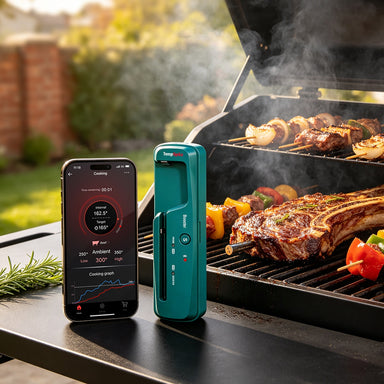
Contrairement aux thermomètres alimentaires traditionnels avec de longs câbles, cet appareil utilise des sondes sans fil. Cela signifie que vous pouvez placer la sonde directement dans les côtelettes de porc, le filet de porc ou l'épaule de porc et surveiller la température depuis votre smartphone.
Ceci est particulièrement utile pour :
- griller des côtelettes de porc à l'extérieur
- fumer du porc effiloché pendant plusieurs heures
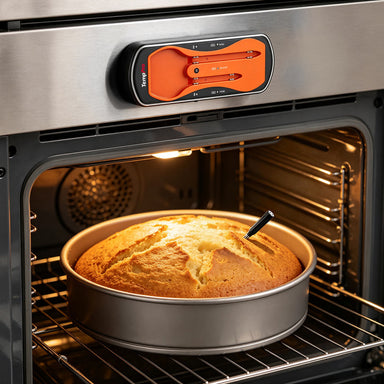
- rôtir du filet mignon de porc au four
Avec un thermomètre à porc sans fil, vous n'avez pas besoin d'ouvrir le grill/fumoir/four à plusieurs reprises et de perdre de la chaleur.
Technologie à double sonde
Le Twin TempSpike Plus comprend deux sondes sans fil, vous permettant de surveiller deux coupes simultanément.
Par exemple, vous pouvez cuire des côtelettes de porc sur le gril et rôtir et rôtir du filet de porc au four en même temps, et surveiller leur progression de cuisson sur votre smartphone ou le booster. Cette fonctionnalité est parfaite pour les dîners de famille ou les barbecues.
Haute précision et lectures rapides
Une mesure précise de la température est la clé d'un excellent porc. Le Twin TempSpike Plus fournit des lectures précises avec une précision de ±0,5°F (±0,1°C) en quelques secondes, vous aidant à atteindre la température parfaite du porc à chaque fois.
Longue portée sans fil
Ce thermomètre de cuisson pour le porc se connecte à une application smartphone avec une portée sans fil étendue de 600 pieds. Cela signifie que vous pouvez vous détendre à l'intérieur tout en surveillant votre porc sur le gril à l'extérieur.
Idéal pour plusieurs recettes de porc
Grâce à sa polyvalence, ce thermomètre alimentaire pour porc fonctionne bien pour de nombreux plats, notamment :
- côtelettes de porc grillées
- filet mignon de porc rôti au four
- épaule de porc fumée
- porc effiloché barbecue
Que vous ayez besoin d'un thermomètre à porc effiloché pour une cuisson lente ou d'un thermomètre à viande rapide pour les côtelettes de porc, cet appareil couvre les deux.

Même le meilleur thermomètre alimentaire pour le porc ne sera d'aucune utilité s'il est mal utilisé. Suivez ces étapes simples :
Étapes pour utiliser le Twin TempSpike Plus afin de mesurer la température du porc
1. Insérez les sondes sans fil dans la partie la plus épaisse
Évitez de toucher l'os ou le gras lors de la mesure de la température du porc, car cela peut affecter la lecture. Pour les morceaux plus minces, insérez la sonde horizontalement à travers le côté de la côtelette pour vous assurer que le capteur est centré dans la viande et ne touche pas l'os ou la poêle. Les os conduisent la chaleur différemment du muscle, ce qui peut entraîner une fausse lecture élevée.
2. Vérifiez la température avant de retirer du feu
Réglez la température de porc souhaitée, par exemple 145℉ dans l'application, et réglez les températures ambiantes les plus élevées/les plus basses que vous préférez pour chaque sonde. Une fois que la température actuelle atteint votre température cible, vous recevrez une alarme de l'application/du booster.
3. Laissez reposer
Une fois que votre thermomètre à viande pour le porc atteint la température cible (généralement 145°F), laissez reposer le porc pendant environ trois minutes pour que les jus se redistribuent.
Cette méthode fonctionne que vous cuisiniez :
- Des côtelettes de porc sur un gril
- Un délicat rôti de filet mignon de porc
- Épaule de porc fumée lentement
FAQ sur la cuisson du porc et la température
Q1. Quelle est la température interne sécuritaire pour le porc ?
L'USDA recommande de cuire les coupes entières de porc, comme les côtelettes, le filet et le filet mignon, à 63°C (145°F), suivies d'un repos de 3 minutes. Le porc haché doit atteindre 71°C (160°F). L'utilisation d'un thermomètre à viande pour le porc garantit la sécurité tout en évitant la surcuisson.
Q2. Pourquoi est-il important d'utiliser un thermomètre à viande pour le porc ?
Les indices visuels comme la couleur ou le temps de cuisson ne sont pas fiables. Le porc peut encore paraître légèrement rosé même lorsqu'il est entièrement cuit. Un thermomètre à viande pour la lecture de la température du porc garantit que la viande est exempte de bactéries nocives comme la salmonelle tout en la gardant juteuse et tendre.
Q3. Comment mesurer précisément la température du porc ?
Insérez la sonde de votre thermomètre à porc dans la partie la plus épaisse de la viande, en évitant l'os ou le gras. Attendez une lecture stable, puis retirez du feu et laissez reposer la viande 3 minutes. Pour les côtelettes de porc, le filet mignon ou le filet de porc, cela assure une cuisson uniforme.

Q4. À quelle température les côtelettes de porc doivent-elles atteindre lors de la cuisson au gril ?
Pour les côtelettes de porc, visez une température interne de 63°C (145°F). Comme les côtelettes sont sujettes à la surcuisson, un thermomètre à viande pour le porc est essentiel. Après avoir atteint 63°C (145°F), laissez reposer la viande pendant 3 minutes pour sceller les jus.
Q5. Pourquoi 145°F est-il le « chiffre magique » pour les côtelettes de porc ?
Cette température est le point où l'USDA a déterminé que la Trichinella spiralis (le parasite historiquement associé au porc) est détruite, tandis que les fibres protéiques restent tendres. L'utilisation d'un thermomètre à viande pour les côtelettes de porc afin d'atteindre 145°F garantit que vous respectez les normes de sécurité modernes sans sacrifier la qualité culinaire de la viande.
Q6. Comment cuire le porc effiloché en toute sécurité et garantir sa tendreté ?
Pour le porc effiloché (généralement issu de l'épaule), cuisez-le à feu doux et longtemps jusqu'à ce qu'il atteigne 90-96°C (195-205°F). Cette température plus élevée décompose le tissu conjonctif pour une viande tendre et effilochable. Utilisez un thermomètre à porc effiloché pour une surveillance précise.
Q7. Le porc peut-il être légèrement rosé au centre et rester sûr ?
Oui, c'est parfaitement sûr. En 2011, l'USDA a mis à jour ses recommandations, abaissant la température interne sécuritaire pour les coupes entières de porc (comme les côtelettes et les rôtis) à 145°F (63°C) suivie d'un repos de trois minutes. À cette température, la viande peut encore avoir un centre rosé, mais elle est sûre à consommer et beaucoup plus juteuse que le porc cuit selon l'ancienne norme de 160°F.
Q8. Quelle est la différence entre le filet de porc et le filet mignon pour la cuisson au four ?
Filet de porc : plus grand, maigre, idéal pour les rôtis traditionnels, conserve bien sa forme, cuit à 145°F.
Filet mignon de porc : plus petit, très maigre, cuit plus rapidement, idéal grillé ou rôti rapidement, également à 145°F de température interne.
Un thermomètre à viande pour le porc aide à éviter de trop cuire le filet mignon et le filet maigres.
Q9. Combien de temps dois-je laisser reposer le porc après la cuisson ?
Laisser reposer le porc pendant 3 à 5 minutes permet aux jus de se redistribuer, évitant ainsi que la viande ne soit sèche. Pour les coupes épaisses comme le filet de porc ou les côtelettes, le temps de repos est particulièrement important. Mesurez toujours la température avec un thermomètre à viande pour le porc avant de le laisser reposer afin de vous assurer d'atteindre la température sécuritaire.
Q10. Est-il préférable d'utiliser un thermomètre à viande sans fil pour le porc ?
Les thermomètres à viande sans fil, comme le thermomètre à viande entièrement sans fil Twin TempSpike Plus, vous permettent de surveiller deux morceaux simultanément sans ouvrir le four ou le gril. Ils fournissent des lectures précises et rapides, réduisent les pertes de chaleur et sont parfaits pour les côtelettes de porc, le filet mignon, le filet ou le porc effiloché.
Q11. Le porc haché a-t-il une température de sécurité différente de celle des côtelettes de porc ?
Absolument. Alors qu'une côtelette de porc n'a besoin d'atteindre que 145°F (63°C), le porc haché doit atteindre 160°F (71°C). C'est parce que le processus de hachage peut propager des bactéries de surface dans tout le lot de viande. Utilisez toujours un thermomètre alimentaire pour le porc afin de vérifier que les hamburgers ou les saucisses atteignent ce seuil de sécurité plus élevé.
Dernières réflexions
Le porc est l'une des protéines les plus populaires, en particulier pour des plats comme les côtelettes de porc, le filet de porc et le porc effiloché fumé. Cependant, obtenir un porc parfaitement cuit exige de la précision. L'utilisation d'un thermomètre à viande pour le porc garantit que vos aliments sont à la fois sûrs et délicieux. Avec la bonne température de porc, vous pouvez éviter la viande sèche et profiter de résultats juteux et savoureux à chaque fois.
Le thermomètre à viande entièrement sans fil Twin TempSpike Plus rend la surveillance du porc plus facile que jamais. Que vous grilliez des côtelettes de porc, rôtissiez un filet de porc ou fumiez lentement du porc effiloché, cet outil peut faire passer votre cuisine au niveau supérieur.
Avec les bonnes connaissances et le bon thermomètre à porc, vous n'aurez plus jamais à deviner la cuisson de votre porc, et chaque repas sera parfait.


Commentaires
Vous aimerez peut-être aussi


Produits recommandés