What Temperature is Simmer? Temperature Guide


 288 Comments


A simmer is generally around 185°F to 205°F (85°C to 96°C), depending on how gentle or active the simmer is. A slow simmer is closer to 185°F, while a more active simmer can reach about 205°F. Water boils at 212°F (100°C) at sea level. The easiest way to recognize a simmer is by looking at the bubbles. You should see small bubbles rising gently through the liquid, rather than the large, rapid bubbles and strong movement of a rolling boil.
What is simmer? What is the difference between simmering and boiling? If you’ve ever tried to cook something that requires a very delicate balance of temperature and time, then you know just how crucial that difference can be.
However, it can be very difficult to determine the exact line between the two and even harder to stay precisely in the right spot. Maybe only the food thermometer can tell it easily. To help make sure your dishes come out perfect, here’s a breakdown of what simmer is, what temperature is simmering on the stove, and how to keep a simmer.
Table of Contents
Boiling vs. Simmering
The difference between boiling and simmering is quite simply a difference in degrees. A simmer is around 185°F-205°F.
Of course, there are some critical physical differences between the two as well, which can let you know whether your water is at a simmer or a boil. A simmer is gentler, with tiny bubbles streaming up beneath the surface. A boil, on the other hand, has a broken surface that bubbles and pops.
| Simmer vs. Boil | Simmer | Boil |
|---|---|---|
| Temperature | About 185–205°F | About 212°F at sea level |
| Bubbles | Small, gentle bubbles | Large, vigorous bubbles |
| Surface Movement | Gentle movement | Strong, constant movement |
| Best For | Soups, sauces, stews, braises | Pasta, blanching, rapid cooking |
The exact temperature of a simmer can vary depending on the liquid, altitude, cookware, and cooking conditions, so the appearance of the liquid is also important.
While a couple of degrees separate the two, but the line can often be fuzzier than you might expect. For example, a quick simmer is more or less the same thing as a slow boil. At the other end of the spectrum, a slower simmer could be looked at as a temperature ideal for poaching.
Benefits of Simmering
Although a recipe may call for simmering, that doesn’t really tell you why you need to simmer. There are several specific benefits that simmering provides over similar cooking methods.
Simmering is versatile when it comes to cooking time. It can cook dishes that require anywhere from a few minutes to hours. The lower temperature than boiling gives you better control over how done the dish will be, reducing the chances of overcooking your food.
Simmering can also greatly enhance the flavor of a dish. All the flavors you add to the liquid will have time to spread and infuse whatever solids you have. It also provides ample time for harder solids to break down, infusing the liquid with those delicious flavors.
Simmering is great when you need to soften certain types of food. A long cooking time plus sub-boiling temperature can soften your food without reducing it to a tasteless mush or only softening the outer layer.
Lastly, simmering minimizes waste and lost nutrition and flavor. Since you’re eating the liquid with the solid, you still get to enjoy all the taste and nutrition that comes from the solids breaking down, as opposed to other cooking methods where all that flavor would get left in the pan.
When to Simmer
Simmering may seem very similar to boiling, but they serve fairly different purposes when it comes to cooking. While boiling is good for quickly heating food, it can also be too harsh for certain ingredients. If you boil some types of fish, you may end up with a mushy mess, but if you simmer them instead, it can come out perfect.
On the same note, simmering tends to provide more thorough heating for dense solids. Where boiling might make the outer edges very hot and leave the inside frozen, simmering will provide lower heat over a longer period of time, allowing the entire solid to get up to the proper temperature.
How to Simmer
When starting a simmer, there are two primary options available. You can either start low and heat up to a simmer or you can go to a boil, then ease down to a simmer.
If you’re going with the first option, then you want to apply heat until the liquid is just starting to show signs of bubbling and faint steam. Lower the heat in accordance with whether you’re looking for a slow simmer, a rapid simmer, or something in between.
If you want to start with a boil and work your way down, then crank up the heat and get to a boil. This is the fastest strategy because it’s actually impossible to overshoot your target by too much. A boil is the hottest water can be (at 212°F), so once you get there, just ease off on the heat a bit and wait for the water to calm a bit.
Once you’ve got a nice simmer going, you need to maintain it. In many cases, this involves a lot of trial and error in figuring out exactly how hot the different settings on your stove are, as well as how conductive the particular pot in question is.
Some quick tricks include moving the pot partially off the burner so that only a portion of the heat goes to the pot, resulting in more of a simmer and less of a boil.
Of course, you do still need to be careful about there not being enough heat to maintain even a simmer. You can also opt for a flame tamer ring, a popular choice for adjusting the heat of your stove and how much gets to your pot.
Simmer Temperature Chart
| Type of Simmer | Approx. Temperature | What It Looks Like |
|---|---|---|
| Slow simmer | 185°F | Very small bubbles with little movement |
| Gentle/regular simmer | 195°F | Small bubbles rise steadily through the liquid |
| Rapid simmer | 205°F | More active bubbling, but not a rolling boil |
| Boiling | 212°F* | Large bubbles rapidly break the surface |
There are three main types of simmers to keep in mind:
- Slow simmers: are generally closer to 185°F and characterized by a lack of motion. Bubbles will be barely visible and the water won’t move much at all, making this a good choice for many dishes that require longer, slower cooking.
- Regular simmers: happen around 195°F and have the characteristic tiny streams of bubbles.
- Rapid simmers: tend to be around 205°F, which still puts them a few degrees short of a typical boil. While rapid simmers and boils do both have a lot of movement, the easiest way to tell them apart is that rapid simmer still tends to have tiny streams of bubbles, whereas boils have much larger individual bubbles.
How to Use a Thermometer to Tell If Water Is Simmering
As you may have gathered, there are two main ways to tell if your water is simmering.
First, a quick look at the water and the amount and size of the bubbles should give you a pretty good idea. However, that isn’t necessarily foolproof and it can be difficult to tell exactly how much of a simmer you’ve got going. Therefore, it’s a good idea to verify the type of simmer with a quick thermometer check.
Remember that 185°F is roughly a slow simmer, 195°F is a standard simmer, and 205°F is a rapid simmer.
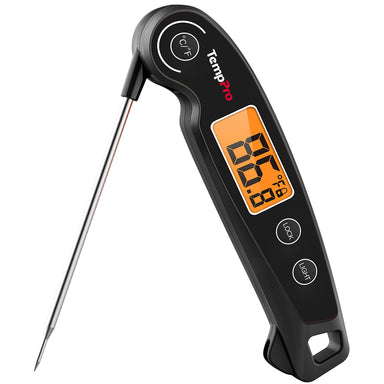
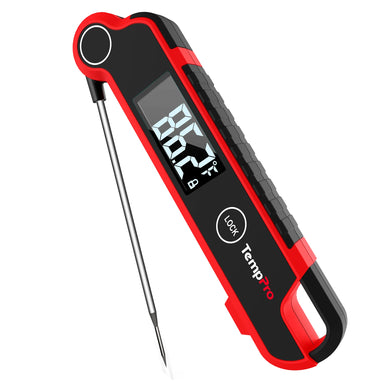
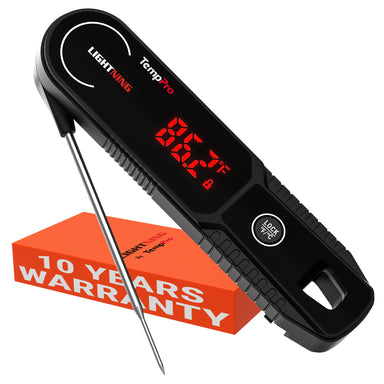
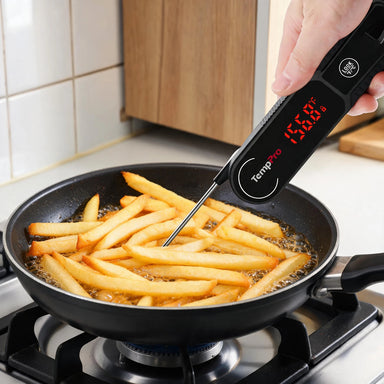
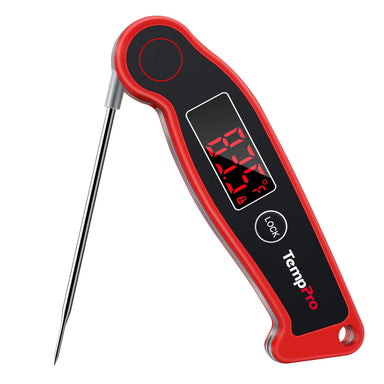
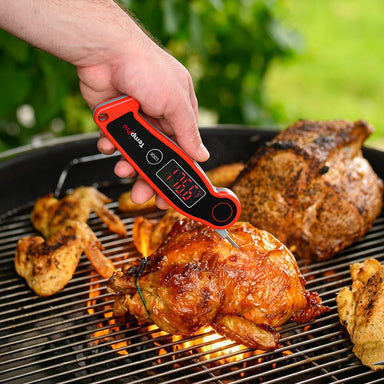
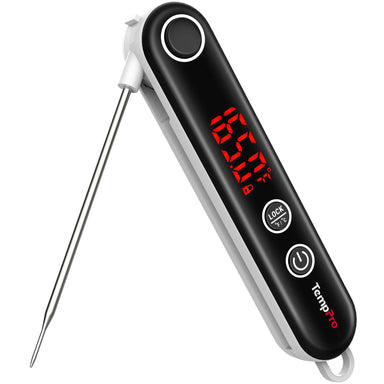
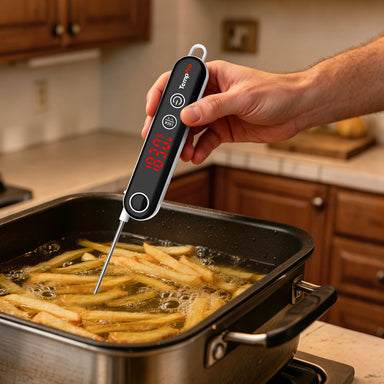
If you’re using a TempPro Food Thermometer, TempPro TempSwift CORE TP15H Instant-Read Meat Thermometer, is a practical choice when you need a quick temperature check while cooking. It provides a reading in about 1 second response time with ±0.9°F accuracy, so you can quickly check whether a sauce, soup, or other liquid is at the temperature you want. Its 5.44-inch stainless steel probe also provides useful reach when checking deeper pots.
- 1-second readings: Quickly check the temperature without keeping the probe in the pot.
- ±0.9°F accuracy: Helps you monitor cooking temperatures more precisely.
- 5.44-inch probe: Provides extra reach for deeper pots and larger batches.
- Temperature Lock: Hold the reading so you can check the temperature safely away from the heat.
- Backlit display: Makes the temperature easier to read in different lighting conditions.
- IPX6 waterproof design: Makes cleanup easier after cooking.
For the most accurate reading, keep the probe tip submerged in the liquid without touching the bottom or sides of the cookware.

To check the temperature of a simmering liquid:
- Stir the liquid first. Gently stir the pot so the heat is more evenly distributed before taking a reading.
- Insert the probe into the liquid. Place the tip in the middle of the liquid rather than against the bottom or sides of the pot. The cookware can be hotter than the liquid and may affect the reading.
- Wait for the temperature to stabilize. An instant-read thermometer can give you a quick reading without leaving the probe in the pot.
- Adjust the heat as needed. If the temperature is getting close to the boiling point and the bubbles become vigorous, lower the heat. If there is very little bubbling and the temperature is too low for your recipe, increase the heat slightly.
- Check again after adjusting the heat. Stove settings can vary, so give the liquid a moment to respond before taking another reading.
For most simmering applications, the liquid will generally be below the boiling point and may fall within the 185°F-205°F range, depending on how gentle or active the simmer is.
Tips for Keeping a Simmer
A simmer can be tricky to get right, but there are a couple of ways you can make the process quite a bit easier.
- First, regulate the temperature not just from below, but from above as well. Turning up the heat is one way to raise the temperature of the water, but adjusting the lid can be quite effective as well, especially for small adjustments. If you put the lid on a pot with a slow simmer, the trapped hot air will drive up the temperature of the water, giving you that little extra push you needed to get into a regular or rapid simmer. Likewise, taking off the lid for a couple of moments can release a lot of steam and bring the temperature down if you’re aiming for something slower.
- Second, adjusting the flow and distribution of heat into the pot can make a big difference. If you’re working with a big pot that has a lot of surface area on the bottom, move the pot relative to the burner, allowing a different part to get heated. You can also stir the water, distributing the heat more evenly and making it easier to tell at a glance what kind of simmer you’ve got going.
- Third, don’t be afraid to add a little extra liquid. If you want to drive the temperature down a bit, then adding some more broth or water can accomplish that faster than nearly any other method.
FAQs about Simmer Temperature
What temperature is a simmer?
A simmer is generally around 185–205°F (85–96°C), although the exact temperature can vary depending on the liquid, cooking vessel, heat level, and altitude. A slow or gentle simmer is usually toward the lower end of this range, while a more active simmer is closer to the upper end.
Temperature is only one way to identify a simmer. You should also look for small bubbles that rise gently through the liquid with mild surface movement. If large bubbles are rapidly breaking across the entire surface, the liquid has reached a boil rather than a simmer.
Is simmering the same as boiling?
No. Simmering and boiling are different levels of cooking heat. A simmer occurs below the boiling point and produces smaller, gentler bubbles with less movement on the surface. A full boil produces larger bubbles that rise rapidly and break across the surface.
Water boils at 212°F (100°C) at sea level, while a simmer generally remains below that temperature. Simmering is often preferred for soups, sauces, stews, and braises because the gentler heat allows ingredients to cook more gradually without the vigorous agitation of a rolling boil.
What temperature is a low simmer?
A low or slow simmer is generally around 185°F (85°C), although there is no single temperature that defines every low simmer. The liquid should be hot with occasional small bubbles rising through it and very little movement on the surface.
If the liquid is completely still, the heat may be too low. If you see large, continuous bubbles or strong surface movement, reduce the heat because the liquid is moving toward a boil.
Can you simmer at 200°F?
Yes. 200°F (93°C) is within the typical simmering range and can produce a moderately active simmer. At this temperature, you should see small bubbles rising steadily through the liquid without the vigorous bubbling associated with a rolling boil.
Whether 200°F is the right temperature for your recipe depends on what you are cooking. Some foods benefit from a gentler simmer, while others may require a more active simmer. Follow the recipe's instructions and use the appearance of the liquid as an additional guide.
How do you know if something is simmering?
Look for small bubbles, gentle movement, and steam coming from the liquid. The bubbles should rise from the bottom and break the surface gradually rather than rapidly covering the entire pot.
You can also use a thermometer if you need a more precise temperature. A simmer is generally below the boiling point and often falls within the 185-205°F range. Because stove settings and cooking conditions vary, using both temperature and visual cues is more reliable than relying on the burner setting alone.
What temperature does water boil at?
At sea level, water boils at approximately 212°F (100°C). However, the boiling point decreases as altitude increases because atmospheric pressure is lower at higher elevations.
This is why a recipe that calls for simmering or boiling may behave differently at high altitude. The liquid can begin boiling at a lower temperature, so it is useful to pay attention to both the temperature and the appearance of the liquid rather than assuming that every pot of water will boil at exactly 212°F.
Why does my simmer keep turning into a boil?
Your heat may simply be too high for the amount of liquid in the pot. Once a liquid reaches a strong boil, reduce the heat gradually until the large bubbles become smaller and less frequent.
The type of cookware, amount of liquid, lid position, and burner can also affect how quickly a pot reaches a boil. If you are having trouble maintaining a consistent simmer, adjust the heat in small increments and watch the surface of the liquid. A thermometer can also help you see how the temperature changes as you adjust the burner.
Should I cover a pot while simmering?
It depends on the recipe. Covering a pot traps heat and steam, which can help maintain a simmer and reduce evaporation. However, keeping the lid on can also cause the liquid to heat more quickly and may lead to boiling if the heat is not reduced.
If you want to reduce a sauce, soup, or braising liquid, leaving the pot partially covered or uncovered allows more moisture to evaporate. Follow the recipe instructions based on whether you want to retain liquid or concentrate the flavors.
Why is simmering better than boiling for some foods?
Simmering provides gentler heat and less agitation than a rolling boil. This makes it useful for dishes that need longer, slower cooking, such as soups, stews, sauces, and braises.
A vigorous boil can cause delicate ingredients to break apart or cause sauces to reduce faster than intended. Simmering gives ingredients more time to cook while helping you maintain better control over the cooking process.
The Bottom Line
Simmers are incredibly useful for cooking delicate ingredients and making your soups just right. They can be spotted at a glance, but if you want to be totally sure about what kind of simmer you have, you can always use a thermometer and see if it’s closer to 185°F, 195°F, or 205°F. Use the tips and tricks listed above to make sure that your food comes out perfect every time.
Knowing the difference between a simmer and a boil can make a big difference when you're following a recipe. A reliable thermometer can also help you check temperatures more precisely when cooking sauces, soups, frying, baking, and more.
Looking for a deal on cooking tools? Visit the TempPro Clearance Sale to find limited-time savings on select thermometers and kitchen essentials.


Comments
You May Also Like


Recommended Products